
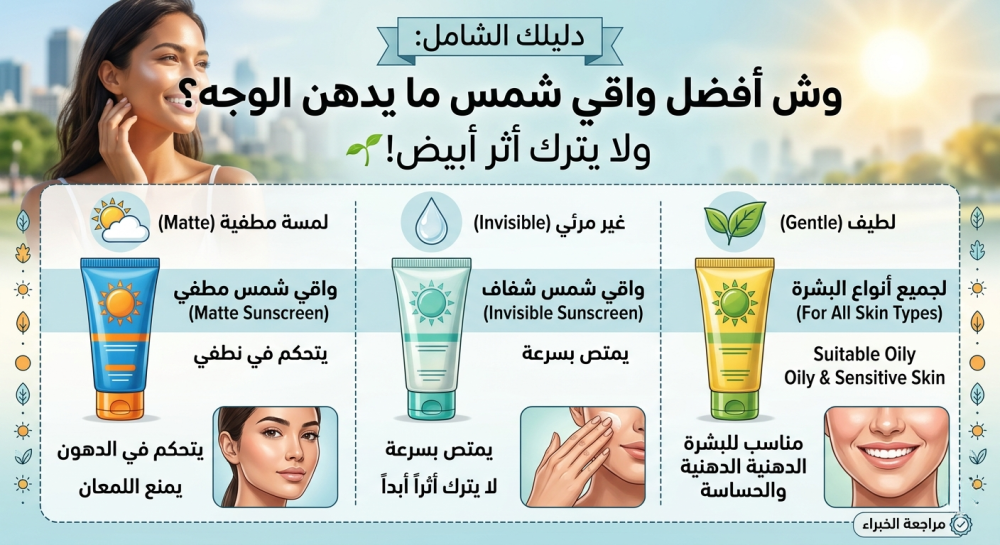
The best non-greasy, non-whitening sunscreen is one with a lightweight (oil-free or gel-based) formula that absorbs quickly, and is often formulated for oily or combination skin. If you're looking for the best comfortable daily sunscreen , choose a product that combines high protection (SPF 50+) with a light, matte finish, such as some of the available options.
La Roche-Posay or Eucerin.
In general, a suitable medical sunscreen should provide:
- Broad protection against UVA and UVB rays
- Fast absorption without a greasy feel
- No white residue left on the skin
Why do some sunscreens leave a white film or a greasy feel?
Not all products are the same, and the main reason for the difference in experience is due to the product's composition.
1. Mineral Filters
Some types of medical sunscreen contain zinc oxide or titanium dioxide, namely:
- It may leave a light white coating
- But it is safe and suitable for sensitive skin.
2. Heavy build
Products with a heavy, creamy consistency may cause:
- Extra shine
- Uncomfortable greasy sensation
3. Skin type
Choosing the best sunscreen depends largely on your skin type, as the same product may be perfect for one person and irritating to another.
How to choose the best sunscreen without a white cast?
To get the best medical sunscreen without any problems, focus on these criteria:
Lightweight Formula
Choose:
- Gel
- Fluid
- Water-based
These formulas reduce the greasy feeling and help with rapid absorption.
Oil-free
If your skin is oily or combination, choosing an oil-free, medical-grade sunscreen is essential to avoid shine.
Invisible Finish technology
Some companies, such as La Roche-Posay and Bioderma, offer technologies:
- Invisible
- No White Cast
It is specially designed to be invisible on the skin.
The best types of medical sunscreen that do not leave a white cast
Choosing the best sunscreen depends on experience, but there are products known for their excellent performance:
1. Liquid sunscreens
- Very light on the skin
- It leaves no white residue.
- Suitable for everyday use
2. Gel Sunscreen
- Ideal for oily skin
- Does not cause shine
- Absorbs quickly
3. Matte Finish Protectors
- Gives a matte finish
- Reduces fat secretion
- An excellent choice as a medical sunscreen for the face
Is it possible to combine protection with a matte finish?
Yes, and you can get both when you choose the best medical sunscreen with an advanced formula.
Modern products from companies like Eucerin offer:
- High protection SPF 50+
- Control sebum production
- Natural look without a white coating
Is sunscreen necessary every day, even without sun?
Yes, using a medical-grade sunscreen daily is essential, even at home, because:
- UVA rays penetrate windows
- Blue light from screens affects the skin
Therefore, using the best sunscreen daily protects the skin from:
- Pigmentation
- premature aging
- skin damage
Mistakes that reduce the effectiveness of sunscreen
Even if you choose the best medical sunscreen , these mistakes can reduce its effectiveness:
- Use a small amount
- Do not reapply
- Choosing an unsuitable skin type
- Relying solely on SPF without UVA protection
Best sunscreen according to skin type
Choosing the best medical sunscreen depends not only on the name, but primarily on the skin type, because every skin type has different needs.
oily skin
If you have oily skin, you need a medical sunscreen :
- Oil-free
- With a matte finish
- fast absorption
This type helps to:
- Reduce shine
- Prevent clogged pores
- Maintain a natural look all day long
Some of the best options in this category are products from La Roche-Posay and Eucerin.
dry skin
Dry skin needs the best sunscreen that contains:
- Extra moisturizers
- light creamy texture
- Protection with hydration at the same time
This helps with:
- Reducing cracks
- Improving skin texture
- Prevent sun-induced dryness
sensitive skin
For sensitive skin, a medical sunscreen should be chosen that features:
- Fragrance-free
- gentle formula
- safe metal filters
This type reduces:
- redness
- irritation
- Sun sensitivity
The difference between chemical and mineral condoms
To understand how to choose the best medical sunscreen , you need to know the difference between the two types:
Mineral Sunscreen
- It acts as a barrier that reflects sunlight.
- Contains Zinc Oxide or Titanium Dioxide
- Suitable for sensitive skin
But it might:
- It leaves a slight white residue in some species.
Chemical Sunscreen
- It absorbs sunlight and converts it into energy.
- Its texture is very light
- It usually doesn't leave a white residue.
but:
- May not be suitable for very sensitive skin
Why do some sunscreens not leave a white residue?
The new generation of medical sunscreens relies on advanced technologies such as:
- Micro-Encapsulation
- Transparent Filters
- Invisible Texture Technology
These technologies make the product:
- Invisible on skin
- fast absorption
- Suitable for daily use under makeup
Sunscreen under makeup
If you use makeup daily, choosing the best sunscreen is very important.
It must be:
- Very light
- It does not cause clumping
- It does not change the color of the foundation.
The best types of medical-grade sunscreen are:
- Fluid
- Gel
- Water-based
Does sunscreen cause acne?
Not all medical-grade sunscreens cause acne, but the problem arises when:
- The product is heavy
- Contains high oils
- The skin is not cleaned properly
Therefore, choosing the best sunscreen suitable for oily skin helps to:
- Reduce the appearance of pimples
- Keep pores clean
How to use sunscreen correctly
Even if you choose the best medical sunscreen , proper application is key:
- Apply a sufficient amount to the face
- Distribute it equally
- Reapply every 2-3 hours
- Use it 15 minutes before sun exposure.
Is sunscreen alone sufficient for protection?
No, using a medical-grade sunscreen is important, but it is not enough on its own.
It is also recommended:
- Wear a hat when exposed to direct sunlight
- Using sunglasses
- Avoid exposure during peak hours
Ingredients to look for in sunscreen
When choosing the best sunscreen , look for:
- SPF 30 or higher
- Broad Spectrum Protection
- Non-comedogenic
- Oil-free for oily skin
These specifications ensure that you get an effective and safe medical sunscreen for daily use.
Can sunscreen be used indoors?
Yes, it is advisable to use the best medical sunscreen even indoors, because:
- UVA rays penetrate glass
- Blue light from screens affects the skin
- Indirect daily exposure causes pigmentation over time
Therefore, using a medical-grade sunscreen daily helps to:
- Reducing premature aging
- Preventing melasma
- Maintaining an even skin tone
Sunscreen suitable for combination skin
Combination skin requires a delicate balance when choosing the best sunscreen , so it is preferable to:
- Light, non-greasy formula
- Control oil secretion
- No white residue
This type of medical sunscreen helps to:
- Reduce shine in the T-zone
- Moisturize dry areas moderately
- Maintain a natural look all day long
Does sunscreen replace moisturizer?
No, even when using the best medical sunscreen , a moisturizer is indispensable.
The correct order for skincare is:
- skin cleansing
- moisturizing cream
- Medical sunscreen
The moisturizer helps to:
- Skin preparation
- Improved absorption of sunscreen
- Prevent dryness
Sunscreen suitable for acne-prone skin
If your skin is prone to acne, you should choose a medical-grade sunscreen that features:
- Non-comedogenic (does not clog pores)
- Very light
- Free from heavy oils
This helps with:
- Reduce the appearance of pimples
- Preventing infections
- Maintaining clear skin
Can makeup with just SPF be relied upon?
It is not recommended to rely solely on makeup containing SPF, because:
- The amount of makeup used is not enough for protection.
- The application cannot be reapplied during the day.
- The protection is less than the best medical sunscreen.
Therefore, a separate medical sunscreen should be used before applying makeup.
When should sunscreen be applied during the daily routine?
For optimal protection, use a medical-grade sunscreen :
- It is placed as the last step in the morning routine.
- 15 minutes before going out
- Reapply every 2-3 hours when exposed to the sun.
Does sunscreen cause clogged pores?
Not all the best sunscreens clog pores, but that can happen when:
- Using heavy products
- Not cleaning the skin properly
- Choosing a formula unsuitable for your skin type
Choosing a light , medical-grade sunscreen greatly reduces this problem.
The importance of SPF in choosing sunscreen
The SPF (Sun Protection Factor) in a medical sunscreen is very important:
- SPF 30: Good protection for everyday use
- SPF 50+: High protection against strong sun
- Broad Spectrum: UVA and UVB protection
The higher the SPF, the more effective the sunscreen is at providing protection.
Sunscreen suitable for long-term daily use
For daily use, it is preferable to choose a medical-grade sunscreen that features:
- Long-lasting stability
- sweat resistance
- A lightweight formula that won't weigh down the skin
This type is suitable:
- For work
- the study
- Daily outing
Does sunscreen completely prevent pigmentation?
This medical-grade sunscreen does not prevent pigmentation 100%, but it does:
- It greatly reduces its appearance
- Prevents it from getting worse
- It protects against the sun's harmful rays.
Therefore, using the best sunscreen daily is an essential step to maintaining even-toned skin.
Quick summary
Choosing the best sunscreen depends not only on the name or price, but also on:
- skin type
- Lightness of the formula
- No white residue
- UVA and UVB protection
The latest generation of medical sunscreens offers advanced solutions that combine:
- High protection
- light texture
- natural matte finish
Frequently Asked Questions (FAQ)
What is the best sunscreen that does not leave a white cast?
The best options are those with a light texture, such as Fluid or Gel, which rely on transparent technologies that do not leave a white cast, and are often ranked among the best medical sunscreens for daily use.
Is medical sunscreen better than regular sunscreen?
Yes, a medical-grade sunscreen is often:
- Safer for sensitive skin
- Fewer irritating ingredients
- Suitable for long-term daily use
Therefore, it is considered a better option for most skin types.
How often should sunscreen be reapplied?
Even when using the best sunscreen , it needs to be reapplied:
- Every 2 to 3 hours when exposed to the sun
- After sweating or swimming
Does sunscreen cause darkening if it is not reapplied?
Yes, even with the use of a medical-grade sunscreen , failure to reapply it leads to:
- weak protection
- Gradual appearance of pigmentation
- Skin darkening over time
Can sunscreen be used with makeup?
Yes, but this is possible on one condition:
- Apply a medical-grade sunscreen first.
- Then makeup
- Or use an SPF spray for replenishment during the day.
Medical and scientific sources
This content was prepared based on reliable medical references and international guidelines in dermatology, including:
- American Academy of Dermatology – Recommendations for Daily Sunscreen Use and UVA/UVB Protection
- American College of Obstetricians and Gynecologists – Skin Safety Guidelines and Ingredients During Daily Use
- US Food and Drug Administration – Regulation of sunscreen ingredients
- National Institutes of Health – Research on the effects of ultraviolet radiation on skin and pigmentation
- Manufacturers' websites such as La Roche-Posay and Eucerin for reviewing formulations and ingredients